- Sounds Profitable and The Download (Weekly Recap)
- Posts
- The Center Cannot Hold
The Center Cannot Hold

Gavin Gaddis
April 1st, 2026

by Tom Webster
Podcast holdouts aren’t missing content. They’re missing a signal strong enough to cut through the platforms they already use—and moderate voices can’t generate that signal.

Everyone’s talking about video podcasting, but what if the industry’s most valuable audience is the one you’re not looking at? In our next webinar, we’re unveiling Audio Primes — a segment of podcast consumers who chose audio deliberately, and whose engagement, loyalty, and influence should reshape how creators, platforms, and advertisers think about the medium. Made possible by RSS.com, this research will surprise you — register now to find out who Audio Primes are, why they matter, and what it means for your business.
Last week, we shared The Last Quarter, our study of the 25% of Americans who have never consumed a podcast, and walked through the broad strokes of who they are, where they spend their media time, and what it might take to reach them. This week, I want to pull on one thread from that data: politics. No, this isn’t a political newsletter. Stick with me.
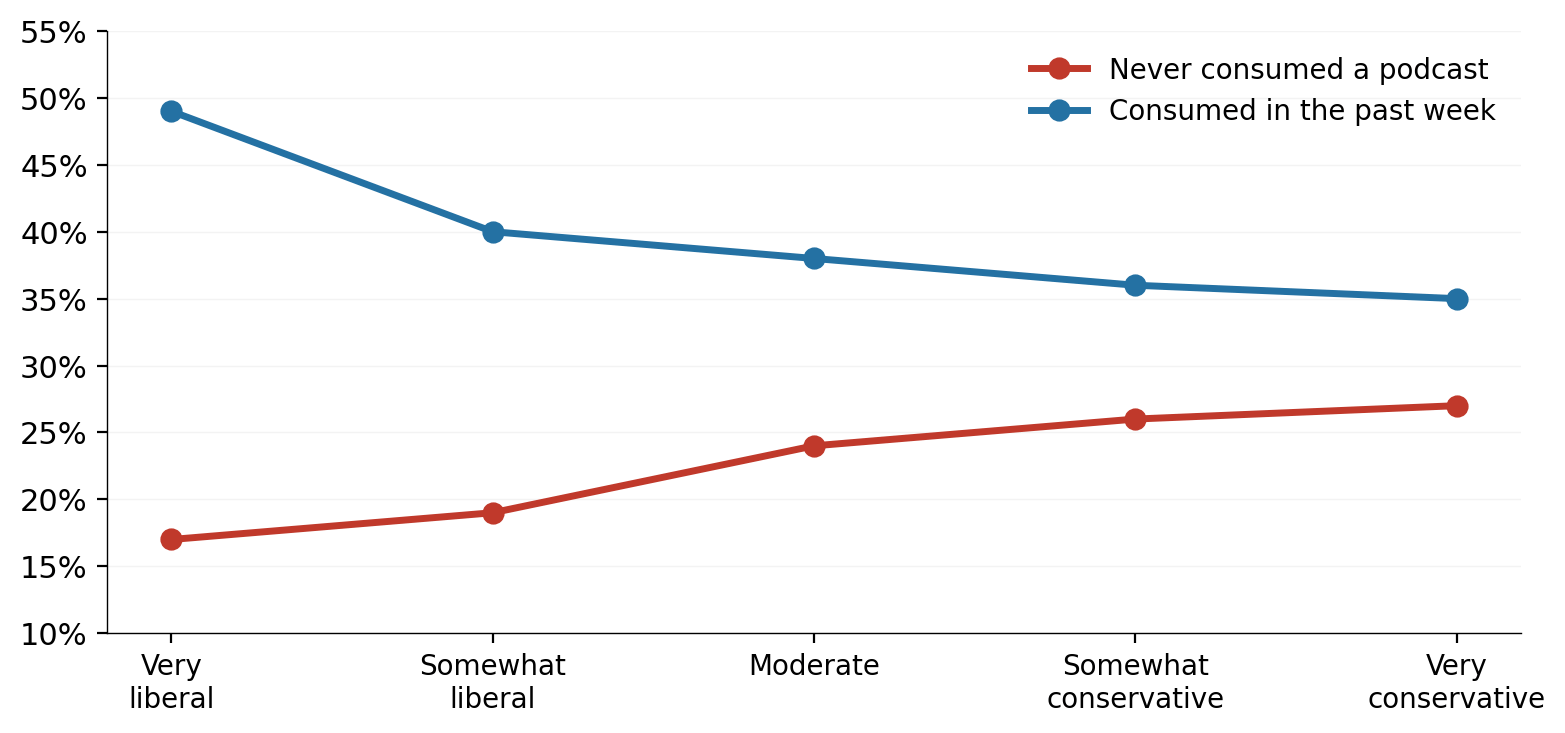
The holdout population isn’t politically neutral. There is a clean, linear gradient running from one end of the political spectrum to the other, and it tells us something important—not just about who hasn’t tried podcasting, but about why. Among Americans who identify as very liberal, just 17% have never consumed a podcast. Among the very conservative, that figure is 27%—ten points higher. And the gradient doesn’t skip steps. It moves in near-perfect order from left to right across all five categories of political identity.
The political gradient of podcast holdouts
“I have never consumed a podcast” — by political identity
Source: The Last Quarter, Sounds Profitable. n = 4,652 (excl. “prefer not to answer”)
This isn’t noise—it’s a real and significant pattern. But if you stopped here, you might conclude that conservatism and podcasting are simply a bad cultural fit. And that would be wrong, because some of the most popular podcasts in America right now are explicitly conservative. Joe Rogan, Tucker Carlson, Ben Shapiro, Dan Bongino, Theo Von—the list of right-leaning shows that dominate podcast charts is long and growing. If conservative Americans were simply uninterested in podcasting, these shows wouldn’t exist at the scale they do.
The answer here is that these aren’t the same conservatives. The Rogan/Shapiro listener tends to be younger, male, digitally fluent, and anti-establishment in orientation—often discovering those shows through YouTube before ever opening a podcast app. The conservative holdout, by contrast, is more likely to be older, female, more traditionally rooted in broadcast media, and less likely to have a strong reason to change media habits. Both self-identify as conservative, but they live in entirely different media ecosystems. The conservative podcast audience that exists is not representative of conservative America writ large. It’s a specific slice—and the slice that’s missing looks nothing like the slice that showed up.
Which raises a sharper question: if the holdout isn’t ideologically opposed to podcasting, what’s actually keeping them out?
Well, we asked. Among the 1,187 respondents who have never consumed a podcast, we broke out their reasons by political identity. The results challenge the simplest version of what you might call the “content gap” thesis.
Why haven’t you consumed a podcast?
Top reasons among holdouts, by political identity (select all that apply)

Among respondents who have never consumed a podcast (n = 1,187). Multiple responses permitted. Source: The Last Quarter, Sounds Profitable
Two things stand out. First, the reasons that would indicate a content gap—“I can’t find a podcast that seems interesting” and “I don’t understand the benefits of podcasts”—are remarkably flat across the political spectrum. The conservative holdout reports these at essentially the same rate as the liberal holdout. Whatever is keeping conservative non-listeners out, it isn’t a conscious sense that podcasting has nothing for them.
Second, the reasons that do diverge are revealing. Conservative holdouts are significantly more likely to cite “not enough free time”—24% versus 15% for liberal holdouts—and less likely to say “my existing entertainment and information options give me what I need” (30% versus 34%). That second finding is counterintuitive: the conservative holdout is actually less likely to report being fully satisfied with their current media diet.
I want to be careful with that “not enough free time” response, which can mean different things. It might reflect literal time poverty, or it may function as a polite way of saying “it’s not a priority.” Either way, it suggests that the barrier is not active rejection of podcasting but rather the absence of a compelling enough reason to adopt a new medium. Nothing has tapped the conservative holdout on the shoulder and said, “This is worth your time.”
So if the conservative holdout isn’t saying “there’s nothing for me” at elevated rates, and isn’t saying “I’m already fully served,” then what explains the gradient? I think the answer lies not in what holdouts think about podcasting, but in the media environments they already inhabit.
We asked all 5,034 respondents—listeners and holdouts alike—about their media consumption across audio, video, and social platforms in the past 30 days. The political patterns are stark.
Media usage in the past 30 days, by political identity
Full sample. Platforms sorted by direction of political skew.
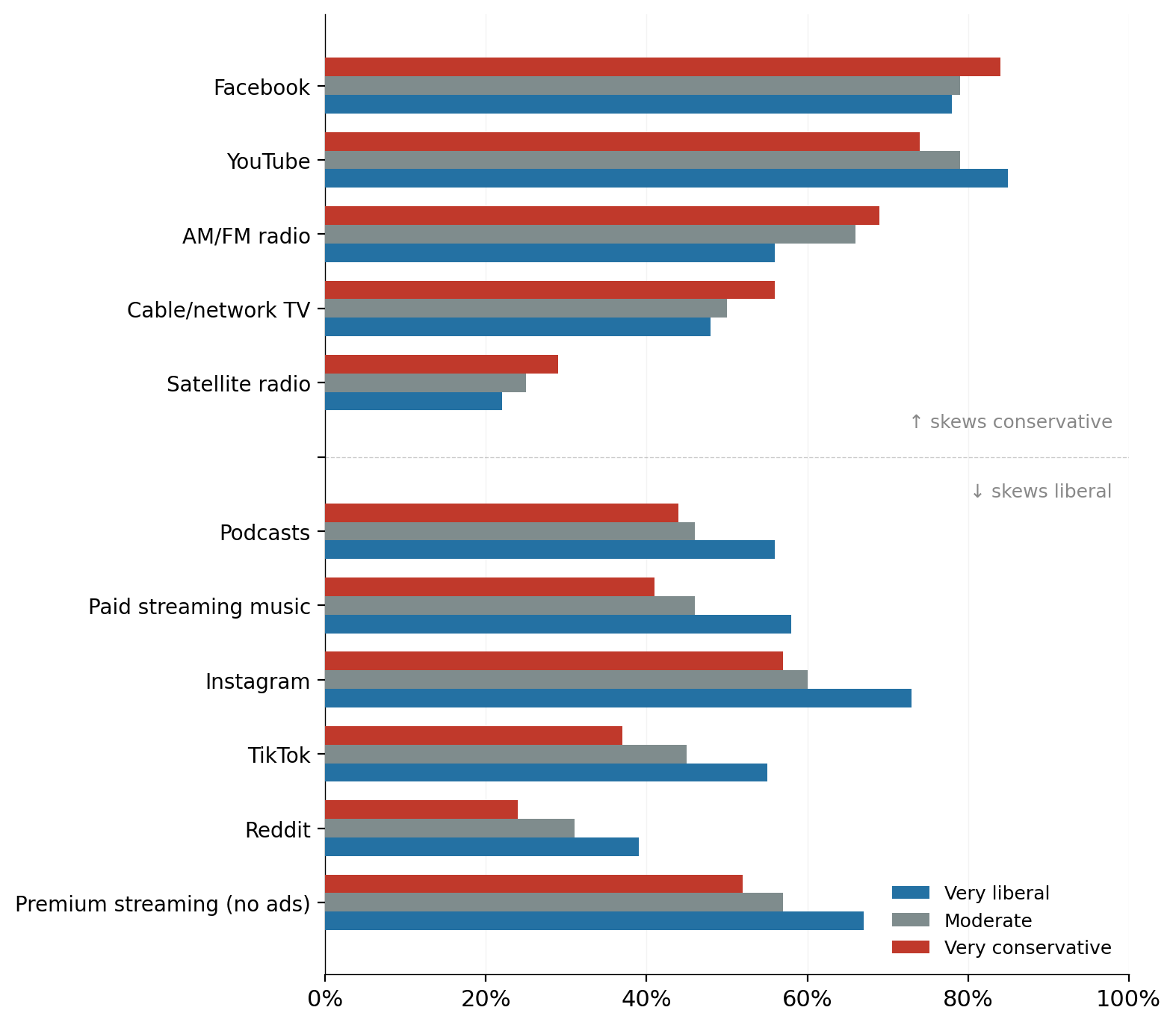
Past 30 days, full sample (n = 5,034). The dashed line separates conservative-skewing platforms (above) from liberal-skewing platforms (below). Source: The Last Quarter, Sounds Profitable.
The conservative media diet is dominated by four platforms: Facebook at 84%, YouTube at 74%, AM/FM broadcast radio at 69%, and network or cable television at 56%. These are not fringe or disconnected people. They are active media consumers. But these four platforms share a critical property: they surface content to you. Facebook’s algorithm decides what appears in your feed. YouTube’s recommendation engine decides what to autoplay next. Broadcast radio and cable TV are programmed by someone else entirely. In none of these environments does the user need to go looking for something new.
Podcasting, by contrast, requires an act of initiative. You have to know a show exists, seek it out, and subscribe. That is a fundamentally different relationship to content than anything in the conservative holdout’s primary media stack.
And this is where the political gradient starts to make sense—not as a story about ideology, but as a story about discovery architecture.
Liberal Americans were drawn to podcasting by an ecosystem that, in its early years, was essentially an extension of public radio culture—NPR, longform interviews, narrative journalism. It wasn’t loud, but it had institutional distribution behind it. NPR told its audience about podcasts. The infrastructure did the work of tapping people on the shoulder.
The hard-right audience was pulled in by a different mechanism. The leading conservative voices used atomized content and strong viewpoints to create clips people would either share in support or incredulity: Rogan clips on YouTube. Shapiro debates shared on Facebook. Daily Wire content engineered for social distribution. The loudness was the strategy, and it worked. We are seeing this strategy now on the other side of the fence, with how rapidly the Meidas Touch network has grown.
The centrist or moderate conservative listener has neither pathway. There is no institutional infrastructure promoting moderate-right podcast content the way NPR promoted its shows. And moderate content, almost by definition, cannot generate the engagement metrics that Facebook and YouTube’s algorithms reward. Nobody screenshots a reasonable, measured take and shares it with outrage or enthusiasm. Nobody hate-shares it, either. It simply doesn’t produce the signal strength required to surface in algorithmic feeds.
The center-right listener has neither an institutional on-ramp nor an algorithmically viable signal. They’re in a discovery dead zone.
This is not a problem unique to podcasting. It is a structural feature of how attention works across all ad-supported digital media right now. Moderate content struggles to surface because the platforms where the moderate audience lives are optimized for emotional valence, rather than balanced information. But podcasting may be an even more extreme version of the problem, because there is no editorial middle layer curating a center lane the way a newspaper front page or a network evening news broadcast still at least attempts to. Every podcast is someone’s passion project, and moderation is nobody’s passion. Well, maybe it’s mine, but that’s because I am the most normal person you know. FOR SURE.
So the political gradient in podcast holdouts is real and significant. But it is best understood not as evidence that conservatives don’t want podcasts, but as evidence that the discovery pathways into podcasting are structurally biased toward the ends of the spectrum and away from the center.
The conservative holdout is a media consumer. They’re on YouTube. They’re on Facebook. They’re listening to radio. They are not hard to reach in a physical sense. But the content that reaches them through those channels is either algorithmically selected for intensity or programmed by legacy media institutions with their own editorial priorities. Moderate podcast content—the kind that might serve a center-right listener looking for informed, measured audio—has no natural distribution pathway to these audiences.
I think this reframes the challenge entirely. We’ve been treating the last quarter as a content problem—build more shows, fill more niches—but for this segment, that’s not what’s missing. It’s a distribution problem. A discovery architecture problem. The question isn’t “what should we make for the center-right holdout?” It’s “how do we build discovery pathways that don’t depend on algorithmic amplification to function?”
In other words, how do we shout about the middle? This is more than a podcasting problem, friends. It’s kind of an American problem.
New Partners
Sounds Profitable exists thanks to the continued support of our amazing partners. Monthly consulting, free tickets to our quarterly events, partner-only webinars, and access to our 1,800+ person slack channel are all benefits of partnering Sounds Profitable.
Audio for everyone. Audacy delivers trusted news, exciting sports, your favorite music and compelling content across 230+ radio brands, premium podcasts, digital experiences and live events that reach over 200M listeners each month
Want to learn more about partnership? Hit reply or send us an email!

